Tuesday, July 08, 2008

On Saturday, July 5th, I saw this, and you didn't:


That's because you probably live in Bat Country, and the people at First Look Internation don't trust your taste. So write them here, and let them know you want to see this movie. I'll even provide you with a template for you to send them:

Dear First Look International,

Even though I live in Bat Country, I have good - no, great - taste in movies. Therefore, I want to see Sukiyaki Western Django. And I swear to God, I won't go during the matinee. No! I'll go during the evening when tickets are full price! Honest! So please send it to my neck of the woods.

Thank you for your time in this matter.

Sincerely,

Your Name Here

So what's it about? Come on, man! It's a Spaghetti Western, set in Japan, directed by Takashi Miike! What more do you want!?!

Fine. Here's the description from the New York Asian Film Fest site:

A nameless gunman (Hideaki Ito) rides into Yuta, Nebada, a dusty flyspeck of a town that’s caught in the middle of a gang war between the Heiki (in red, and led by hot-headed madman, Koichi Sato) and the Genji (in cool white, led by baby-faced bad boy, Yusuke Iseya). Setting the two gangs against each other and hoping he can pick up the cash left on the table after they wipe each other out, our hero soon finds things are a bit more complicated than he assumed. There’s the mother of a half-Genji, half-Heiki kid, played by Yoshino Kimura (FINE, TOTALLY FINE)who is out for revenge against the Heiki; her mother, who runs the local general store and who is secretly a legendary gunslinger herself (played by Kaori Momoi, MEMOIRS OF A GEISHA), an indestructible sheriff and more mind-bending, cartoonish ultra-violence than you thought could ever possibly exist, all scored to a thundering, electrifying spaghetti western soundtrack.

Speaking a “Hooked on Phonics” version of English, the cast wades into this cross-cultural mash-up with guns blazing, slaughtering anything that moves and taking no prisoners in this off the hook Western that manages to load a missile with everything cool about samurai movies, westerns, spaghetti westerns and Takashi Miike movies and launch it into your eyes.
How could you NOT want to see this? There's no way! It's opening here in the big city in a month, and First Look is a bit antsy on a wider release. So you need to tell them you want to see it.

Now, it's not Ichi the Killer violent/bloody. But it's bloodier than your typical Spaghetti Western. And all the tropes are there: The warring gangs, the Romeo & Juliet love story, the nameless gun slinger, the morally ambiguous sheriff, and so on. Miike steals from Leone's trilogy (The Good the Bad and the Ugly, A Fistfull of Dollars, A Few Dollars More) freely, and it works, because they're sly thefts, nothing too obvious.

Quentin Tarantino does act in this. He's in the opening scene, and while he does well here, he's better in later scenes stuck in a steampunk wheelchair and covered on oldman latex. Miike manages to get some real acting out of Tarantino in these later scenes, when he seems to focus more on emotional reactions than the earlier cool grandstanding.

But my favorite character is Kaori Momoi's Ruriko, the secret gunslinger. There's nothing like an older woman slinging iron with the best of them. She steals the show for several reasons, one of which is the surprise of an older woman spotlighted in a Japanese movie.

So go and First Look you want to see this. Do it now. Because good movies are worth your time and effort, and this, my friends, is a great movie.

Friday, June 27, 2008

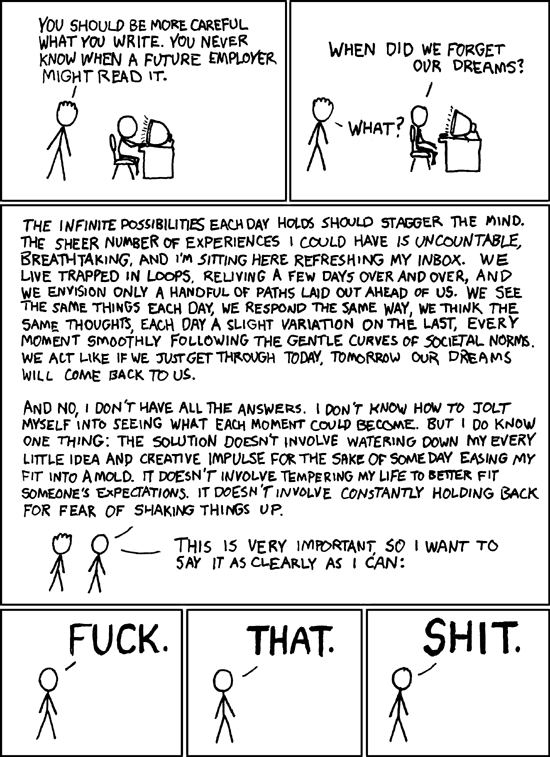
Don't be afraid to make mistakes.

Friday, May 09, 2008

Wish I'd Found this years ago.

Friday, February 29, 2008


This is how I usually feel when I'm at work... or anywhere else for that matter.


Tuesday, January 08, 2008

I'm not sure how I found Jucifer. It's been a while, and I've downloaded some of their stuff, which I really like. They're pretty much a noise-core band from Georgia. But let's be honest here: It's a girl with a guitar, and you know my weakness for that combination.


Friday, January 04, 2008


I went on a movie binge last night... well, it was two movies, so it wasn't much of a binge, but it's been months since I've sat in an actual movie theater, and once I was in, I had to go back at least one more time. See, I was thinking I would do a marathon tonight, but I'm busy. I'm making another movie with Film School Girl (FSG from here on out), and since she's the director, when she says "Jump," I ask "How high" while my feet are already leaving the ground. Some of you know FSG from my time over at Straight Dope. So you know what an idiot I am for doing this.

Maybe "idiot" is too strong a word. Probably not, though.

That's not the point, though. The point is, I finally saw Persepolis, the film adaptation of the graphic novel. I reviewed the first book of Persepolis way back when Here's the link. I've actually found that the further away I get from that review, the more I love the book. Not that I gave it a bad review. Hell, that quote from USA Today you see on the copy of the book (not that new single edition, but the old split edition), that's me. I just wasn't as enchanted by the art as I am now.

So after having seen the film, I have to say that 2007 was a great year for animation. I haven't seen all of the "live action" movies that are being hailed as the greatest things in the world (I'm working on it), but if you asked me to name five films that stood out in 2007, it would be reasonable to cite four animated films, Persepolis among them.

Persepolis tells the tale of Marjane Satrapi (the author), as she grows up in Iran during the time of the revolution, her time in Vienna as a teen, and then her return to Iran as a young woman during the repressive time of the Ayatolla. The animation in the film reflects what Satrapi put in her graphic novel. However, with the advent of doing this movie digitally (it's still technically 2-D), there is some visual depth that was missing from the graphic novel.

This may sound like I'm downing on the graphic novel, but I'm not. Not only should you go out and see this movie, you shoudl buy the book, preferably the version with my quote on the cover. Once you buy that book, you should write the publisher and let them know it was my quote that caused you to buy the book, and that it should be displayed prominantly on ever edition from here on out. With my name included in the citation.

I'm just sayin'.

In my review, I wrote that the book was "a mighty achievement," and the film is no less. In fact, let me write it for the film: "A mighty achievement." I mean, it's beautiful. Most of it is in black and white and shades of gray. The characters are simply drawn, but incredibly expressive, so much so that I have to admit that I got teary-eyed a few times during the movie.

One thing, though, that struck me when I read the book, and again when I saw the movie, was the diversity of the characters. It seems that whenever we here in the States see depictions of Muslims in the news - or even just in the media in general - we get one image: The zealot. The fundamentalist. Some yahoo in a turban, chanting something about the great Satan; a woman in a burqa or chador, scurrying through the streets, a couple steps behind a man.

In Persepolis, Satrapi shows a world where there are shades of gray (hence the color scheme), where the women talk about sex (apparently to some Iranian women, it is the size of the paddle, not the motion of the ocean), the men talk about Marxist revolution, everyone wants to have fun, and Marjane wears a "Punk is not Ded!" back patch.

It's the kind of reminder that we need these days that our supposed enemy has a face, has nuances, is just as gray as the rest of us.

Sunday, December 23, 2007

I know, it's been a loooong time since I wrote anything here. But it's almost Christmas, so here's a Christmas video for all of you loyal readers.


Monday, September 17, 2007

Finally! I finished reading something! And not just any something, but TekkonKinKreet. Originally released by Viz Publishing, it was called Black & White, and I have to say, I have the first of the trilogy. And I loved it. But I never bought the other books, because as much as I loved it, I found it a touch disturbing, a little too violent for my tastes at the time. And this a guy who loved Ichi the Killer. But this was before Ichi. This was before Imprint.

This summer, Sony Pictures released the film version of Taiyo Matsumoto's TekkonKinKreet, and of course I went to see it. Of course, I didn't do a write up of the film. I forget why. But thank God Viz Media released the series in one big honkin' book! Which I immediately bought this week, and read over the course of a train ride to my friend's house.

It is one of the most crazy, innovative manga I've read in years. The main characters, Black and White, aren't your typical Bambi-eyed characters. The lines aren't those Zen smooth lines you see in books like Love Hina, or Gundam. It's energetic, frenetic, violent, and a little feral. Just like the main characters.

So, the story: Two orphans, Black and White, fight rival gangs, Yakuza, the cops, and even a construction company in their city, Treasure Town. Times are changing, and so is the city. And as the city changes, so do the boys, who try to keep things the way they always were for their 10 short years on this planet. Black, the most obviously cognizant of the situation, does most of the fighting. White, on the other hand, seems developmentally challanged. He can't tie his own shoes, and he's just learned to count to 10. Their fight to keep their city whole is exciting and scary, but as the book moves along, I had to wonder, was it worth it?

The great part of Matsumoto's work is that's exactly the question. Can we stop change? If you listen to Frank Zappa, who said (and I paraphrase), not only is change necessary, it's inevitable, then no, you can't stop it. And why would you want to? I look around at Manhattan, and even Brooklyn and parts of the Bronx, and change is coming. Even in Queens, change is happening. Sometimes it seems like the city is turning into a great big strip mall. Other times, it's like a playground for the rich. Out on Rockaway Beach, some yahoo is building condos that'll start at 500K for a studio. You ever been to Rockaway? There's not much out there. Nothing to warrant a studio for that much money, anway.

That's just me being a little maudlin.

Anyway, back to the book.

How does it end?Does Black save his city? Can the city even be saved? Does the city even need to be saved? And what about White? Does Black save White? Or is the fight really the other way around? These are questions worth exploring for yourself.

Friday, September 14, 2007

I looove the Dead Kennedys, and I love the Foo Fighters (I met Dave Grohl in Alexandria, Virginia one night not too long ago), and I love System of a Down. This cover version of Holiday in Cambodia makes me wish two things:

1. I wish I'd actually been at the VMAs this year.

2. I wish there was a comparable band to the Dead Kennedys in the day and age.

Tuesday, September 04, 2007

Jesus Christ! It's been more than a month since I've done this. And it's not like I haven't seen or read anything in that time. I've been reading, but I havent' finished anything, so that's part of it. And when it comes to the movies I've seen...

Go see The Bourne Identity. In fact, watch the first two films before you go, then head out and watch TBI. It's neat the way Paul Greengrass bookends the series with the closing image. It's the entire movie in two shots. And Superbad fucking rocked. It did the same thing with its opening and closing images. It's good writing, and good filmmaking. At least, I think it is.

As for the books I've been reading, I started Cormac McCarthy's Blood Meridian, but I can't finish it. It's a mess. A lovely mess, sure, but a mess nevertheless. The man should have done poetry. There's no story to the book. But it's a pretty read.

I'm going back to school in two weeks. The New York Film Academy accepted me for their 12-week digital movie making course. And why shouldn't they? I'm beautiful. So if you think I've been slacking off lately, it's gonna get worse.

Friday, July 13, 2007


It's been a bit - about two weeks - but I saw Park Chan-Wook's new film, I'm a Cyborg, But That's Okay at the New York Asian Film Festival. I've let it sink in, marinate, let it get a little tastier in my memory. And the thing is, I wouldn't say Chan-Wook fumbled the ball on this, but it's no Lady Vengeance or Oldboy. Those are hard acts to follow, and I can't say I'm disappointed by Cyborg - hell, Chan-Wook's movies are like pizza. Even when they're bad, they're good.

Man, I'm making this sound bad. Lemme start again.

Park Chan-Wook's new film, I'm a Cyborg, But That's Okay is a whimsical film, a grand departure from Oldboy, Lady Vengeance, and even Joint Security Area. And while that whimsy is enough to carry the movie from start to finish, it's not without its flaws. But first, what it's about:

Cha Young-goon (a young woman, played by Su-jeong Lim, who I think is actually very cute, despite the eyebrows) thinks she's a combat cyborg who's sole job is to get a set of dentures back into her grandmother's possession. While at work building a radio, she slits her wrist, and inserts some live wires so she can power up. This gets her sent to a mental hospital. And why wouldn't it? While there, she meets an interesting cast of characters, including the male lead, some guy named RAIN (his character is Park Il-sun, and RAIN was voted Time.com's most influential person in the world... go fig). Park's deal is that he steals. But he steals other people's mental problems. At one point, Cha wants him to steal her sympathy, so she can go on a killing spree and bring her mission to a close.

Yeah, I know.

My only problem with the film - and ultimately, it's a pretty big problem - is that Cha's problem isn't really explored, even though it's a pretty important part of the film. Why does she think she's a cyborg? It's obviously a defense mechanism, so why is it there? We get to see it in glimpses, and it's never really resolved. Now, I have no problem with it having no resolution, but I'd loved to have seen more of it.

Nevertheless, I recommend you check this out if it comes to a theater near you. There are plenty of good laughs here, and there are moments that move toward poignant (they coulda made it, too, had Chan-Wook delved into Cha's background more).

Saturday, June 30, 2007

The New York Asian Film Fest is in town. I found out from a friend, who linked me up with SubwayCinema.com, where you can find all the details (and if you're not from NYC, you can weep with the envy of 10,000 movie geeks who don't live in NYC). Over the last week, I've seen two Miike films, Big Bang Love: Juvenile A, and just today, Zebraman. Tonight, it's Park Chan Wook's new one, I'm a Cyborg, But That's Okay.

Since I've seen the Miike flicks, I'm going to do a mini review in order of both. You'll have to wait for Cyborg. I'm heading to North Carolina, and I'm not sure I'll have Internet access there. Not that North Carolina doesn't have the Internet.

As you know, I've been a Miike fan since 2001. And before this week, I've seen only one of his movies on the big screen: The Audition. So since I've had the chance to see two more, I took it. I've been busy this week. My bathroom ceiling sprung 1,000 leaks. I've been working overtime to get out of the office for my vacation. I haven't had time for friends. But this is Miike we're talking about. On the big screen.


Big Bang Love is about a year old now. And for those of you who want to see it expecting the usual kinetic camerawork, the usual arterial spray, the usual deviant behavior, well, I'm sorry. It's not here. Not that this isn't weird and violent. It's just not Miike violent. In fact, it has more in common in its staging with Lars Von Trier's Dogville than anything I've seen of Miike's, and at this point, that's about 2/5s of his films, which is a fair number.

The story is about two men, Jun and Shiro, who arrive at prison on the same day for the same crime: Murder. The film opens with Shiro strangling Jun, which strikes everyone at the prison as strange, because the consensus was that they were lovers. So an investigation is begun into the murder, and it's a pretty straightforward police procedural from there. Except, this is a Miike film.

In a jail where there seem to be no walls, only darkness, two cops question inmates, guards, and the warden, who's had a run-in with Jun before to tragic results. Everyone has a motive, except Shiro. In fact, Jun protected Shiro, and as I wrote above, people thought they were an item, the main evidence of which was a supposed tryst they had together in the shadow of a rocket ship and Mayan temple, both of which were just beyond the walls of the prison yard.

It's been said in other reviews that the temple represents faith, and the rocket science. And I think they're only half right. They also, I believe, reflect the natures of the two main characters, Shiro being the rocket ship, and Jun the temple.

This is a movie, I think, for Miike die-hards, though it doesn't reflect their taste in his movies. I'm not so sure it's a must-see for anyone else, other than the art-house crowd who are in to avant garde films. Miike takes big risks here as a filmmaker, mainly with his fans. Does he succeed? I'm not entirely sure. I get the feeling that he was interested in trying something out, and now that he has, he's moved on to Spaghetti Westerns and high school gang movies.


That curiosity, though, brings me to Zebraman, Miike's first "family" film. I write it that way, because the film opens with a Defense Department agent complaining of a case of crabs, and his partner scolding him about seeing cheap hookers. Also, various characters say "fuck" about three times, making this an R film in the U.S.

Zebraman is about a school teacher, Mr. Ichikawa, played by Sho Aikawa, a Miike regular. Ichikawa's life sucks. His wife is having an affair, his son is bullied at the school, and his daughter doesn't respect him. His only solace is found in an old TV show, Zebraman, which is very much like the... ahem... Might Morphin' Power Rangers. But when green gummy aliens invade, only Zebraman can stop them. So Ichikawa dons his homemade costume, and sets about ridding the world of these dastardly invaders.

Okay, this is definitely not Miike's normal kind of film. There's very, very, very little blood in this. And no one's really all that weird. There's no perverted sex, or anything! But I have to admit, I really liked this movie. It's not great by any standard. I mean, if I took a slice of it, put it between two pieces of bread and slapped it on a griddle, I'd have a nice grilled cheese sandwich. But damn if this movie doesn't have heart. And if Sho Aikawa weren't in the lead, this movie wouldn't work at all, and to be honest, there are times when I think it has no right to work as well as it does. But it does work, and I was clapping by the end.

Zebraman will be out on DVD later this year, which is part of why it's at the festival. I would suggest all Miike fans at least rent it, because it's goofy good fun. And if you invite your friends over to see it, well, make sure they're either drunk or high.

Monday, June 25, 2007


There are going to spoilers ahead, so if you haven't seen Hostel Part 2, well, turn back now, I suppose.

The thing is, I went to this not expecting too much other than a visceral thrill or two, and I hate to say it, but I didn't get it. That's not to say Eli Roth isn't a good director. He's getting there, I think. But the script was flawed, and since the foundation of the story wasn't there, ultimately, the movie was a disappointment.

Some background: Hostel Part 2 picks right up where Hostel left off, which is all well and good. This time, it's about a group of college women off to Slovakia where they hit a spa, are kidnapped, and tortured. There's a twist at the end, which isn't much of a twist, though it's very interesting - or it could have been - and then it's over.

The problem for me wasn't so much the weak theme (money will get you out of anything), but how Roth presented the set pieces. It was as if they were jokes. I spent most of my time laughing at the movie, as did the rest of the crowd (except one guy, who walked out at the end, calling us idiots for laughing at the movie - he had an eastern European accent, so he may have been angry at Slovakia's portrayal... I don't know). The only part of the movie that got any "horror-movie" reaction out of me is when Beth is punched in the face.

The context of that punch is that she's trying to escape after her torturer has second thoughts. Then he kind of changes his mind. The punch comes out of nowhere, and I jumped. But when a girl gets her throat cut and there's arterial spray? Nothin'. When a circular saw gets caught in another victim's hair? Nada. When a torture dines on some thigh meat? That is so Hannibal Lecter.

Maybe it's because I re-watched Ichi the Killer the night before. That was a disturbing movie. But the relationship between the violence and the characters is stronger. And I think Roth doesn't realize that completely. Not yet anyway. Because his violence is divorced from the characters. He had a chance with the character Stuart to show us how horrifying this whole thing could be, but he doesn't, and that's a shame. Perhaps there will be more on the DVD, but I doubt it.

I'd say skip it, but considering its box office take, it looks like you already have.

Wednesday, June 20, 2007

A few weeks ago, I picked up The Turn of the Screw by Henry James. I would never have done so were it not for Lost, since it's one the show's "reading list," which includes such books as The Third Policeman, A Wrinkle in Time, Watership Down, and The Brothers Karamazov (much to my chagrin). Henry James, as you may or may not know, has a reputation as being a hard read for casual readers. His sentences are complex, his descriptions can be dense. Nevertheless, this was a read for a great cause: Figuring out what the hell is happening on that damn island in Lost.

Turn takes place at a large country house in the English countryside. Our narrator is a young governess (never named, which seems to be a trend in the books I'm reading these days - see Grotesque) left with two young charges, Milo - the elder boy - and Flora, his sister. Flora is a kind enough child, but Milo is another story. He's been kicked out of school, for what we're never certain, except that he's a threat to other children.

Over time, the governess hears and sees strange things around the country house, including two spectral forms, a man and woman, who are the former (and late) groundskeeper and governess, respectively. Both died, it turns out, under curious circumstances. The governess perceives them as a threat, and takes what she believes is the appropriate action. The ending, however, is tragic.

Well, not really. Or, it didn't feel that way to me. Perhaps it's because I've been raised on Stephen King and Clive Barker when it comes to horror - and make no mistake, this is a horror story - but it didn't strike me that James had much of a grasp of the genre. Some might argue that he was making a larger point, but I'll be damned if I know what it is. As for Milo being a threat? It never really comes across, probably because we barely spend any time with him or his sister. Most of the novella is the governess running about talking to one of the housekeepers, Mrs. Grose. When Milo or Flora do speak, it's only for a few lines.

Did Milo kill the groundskeeper and his former governess? Perhaps. But I wasn't very invested in the story. Don't get me wrong, I get it: James is a grand writer, but I don't think his style fit the genre. I get the impression that in his other novels, like The Portrait of a Lady or The Wings of the Dove, what passes for horror - or at least tension - are the little foibles and common loves of society's elite. Then again, I haven't read them, so what the hell do I know?

But most importantly, what does this all have to do with Lost? What does it reveal about the show? It perhaps reveals to us why Jack saw his father, Christian, on the island; why Ben saw his mother; why Kate saw that horse; perhaps even why Locke and Sawyer saw Locke's father, and why Richard hasn't aged and has forgotten birthdays. There has been mention of hostiles on the island, and perhaps they are all like the ghosts of The Turn of the Screw, reminders of the sins of the survivors, or of survivors past.

The more books I read from the Lost reading list, the clearer things become. I don't know what I'm going to read next, but I'm thinking Watership Down, which I haven't read in years. That, or Are You There God? It's Me, Margaret.

Wednesday, June 13, 2007

Just to swing you guys around to my other blogs, they're back in business. So go look at them. The one for the movie even has a picture!

As for another post here, I'll have something soon for The Turn of the Screw. I was going to finish it this morning, but the train must have been running fast, or I was reading slow, and I didn't finish it. Perhaps tonight? I dunno.

I've also Netflixed myself recently. I took up their offer of two free weeks or whatever it was. Anyway, I already have a queue of nearly 350 movies, and I've rated nearly 2,000 movies, most of which suck. I never realized how much time I wasted in front of a movie or TV screen. And now I'm wasting a lot of time in front of a computer monitor. Is that a step forward? I don't know. I'll let someone else answer that.

The point is, I've already gone through six DVDs, and I've reviewed only one. I've been watching a lot of Takashi Miike's stuff, though tonight I'm going to watch The Glamorous Life of Sachiko Hanai, which I think is going to be a good time, because it's a Japanese Pink Movie, which means nudity and simulated sex. In this case, it's with George W. Bush's severed finger sometimes, so you know it's going to be... interesting.

Will I review all the movies I've skipped over? Probably not. I'll just say that Dead or Alive: Birds is rather lovely, Dead or Alive: Final makes sense in the context of the entire series, and the robot at the end is fucking awesome, especially its head. Gozu has its moments, and could have used a tighter editing, but overall it was a great movie. As for Terry Gilliam's Tideland, I'm not sure what to say except that the parts are better than the whole.

So, next time, a review of The Turn of the Screw, and perhaps of Sachiko. Who knows?

Tuesday, May 29, 2007

I've been tagged by Fermicat to do a meme, 8 facts about me, and then I'm supposed to tag 8 other bloggers. The problem is, I think Fermi tagged all the bloggers I know! So it ends with me - at least, this branch of it ends with me.

1. I blame my cousin for my taste in music. When I was 14 or so, I was visiting my cousin Bobby and his wife in Ohio. And in Bobby's CD collection was one of the few albums that would change my life forever: Never Mind the Bollocks, Here's the Sex Pistols. To this day it is one of my favorite albums, and one of my favorite bands. It defined a way of thinking for me. Punk isn't a musical style of me, either. Johnny Rotten has made that clear in the way he has evolved over the years. It's a way of being. Johnny Cash is Punk. So is Hank Williams, Sr. Takashi Miike is Punk, and he's a filmmaker. The guys who made Six String Samurai are Punk. And one day, when I'm dead and gone, I hope someone looks back and says, "Yeah, man, Chris was a Punk."

2. I lived near a notorious murder scene. Yes, I've said it before, and I'll say it again, until December 20th, 2006, I lived within two blocks of the murder site of Kitty Genovese. It used to be an apartment complex, but now it's a steakhouse, comic book store, barber shop, vegetable market, and cafe. It's an unassuming site, and looks nothing like depicted in Alan Moore's Watchmen. The fact is, part of me is morbidly proud to have lived there, and another part of me is sad whenever I think about it. No one did a thing to help her. I would like to think that things would be different nowadays, and from what I've seen, for the most part they are. Of course, I've been wrong before.

3. I'm a military brat. Air Force to be exact. I lived mostly in the Southeast of the U.S., and according to my mum, we moved 13 times in 11 years. I don't think that was to different states and/or bases. I think it was total. I remember moving twice within the Washington, DC area when I was between the ages of 3 and 5. So that's two. And I imagine more moves like that happened. I don't recommend having kids if you're in the military, especially if you plan on fostering your career and moving to wherever the military tells you to move. Some psychologists liken moving a kid around that much to abuse. Some want to classify it as such. I'm not sure I'd go that far, but it's not the best thing to put a kid through.

4. I lived in Singapore. It was only for about six months, back in 1997/98. I was with my ex-wife at the time - we weren't married. It was hot, sure, but it was the humidity that really did me in most days. And it was a lot of fun, to be honest. I worked as a Tech Writer - under the table, of course - and the only reason I left was because I couldn't get a work permit. I lived with my future in-laws, made nice with the locals at the food stalls, worked with a guy who had been an assistant to the Arthur C. Clarke, and sweat a lot. The food was fantastic. I'm not big on seafood, but over there, I could have eaten half the ocean's fish. And if you ever go - and you should go for about a week - you have to have the Hainanese Chicken Rice. There is no excuse.

5. I took Latin in highschool and college. It was actually my favorite class, looking back on it, especially in college. I wish I'd been better at it, because I actually still use it. When it comes to grammar and whatnot, I use a dictionary less than my colleagues. And it grinds my ass when people misuse words like "decimated," like when a newscaster says something like, "The neighborhood was decimated by the tornado." Well, decimated means 1/10th, you bastards! And you've gone and distorted our fair language and now it means entirely! I could kill someone over this, but I don't know whom to blame.

6. None of my jokes translate. What I mean is this: Right now, I'm seeing a woman who doesn't speak much English. In fact, she understands some English, but speaks next to none. She speaks Spanish. Normally, when I'm seeing a woman - wooing a woman - one of my... well, weapons isn't the right word, but it's the first one that comes to mind - one of my weapons is humor. So I started to think of all the jokes I know. And they all rely on wordplay. So I've had to rely on other things in my arsenal, like consideration, and sincerity, and so on.

7. Metal is my religion, and Judas is my priest. Not really, but it's a fucking awesome t-shirt, ain't it?

8. I'm just trying to be a better person. Like the show, My Name is Earl, where the hero, Earl Hickey, tries to reform his ways and make good so Karma doesn't kick him in the ass anymore. I was never that bad to begin with, but still, I want to leave the world a better place than when I arrived. I don't always know what that means, and not everyone wants help even if they so obviously need it (as I've recently found out). I've also found out that sometimes, to help someone, you have to be an asshole, and you sometimes have to be their rival, or even their enemy. Sometimes, I've found, people will take advantage of that. But when it comes down to it, though, I'd rather do something good and be taken advantage of, than do nothing at all, or even something bad.

Thursday, May 24, 2007


I first encounted Takashi Miike back in 2001, with a screening of The Audition in Washington, DC. It blew me away, and made 10 people walk out in what I guess was disgust (needles and piano wire were involved, so I can kind of understand). One guy even fainted! It was the best movie of the year, and still one I hold close to my heart. Since then, I've been a Miike fan, and I've seen Ichi the Killer, Dead or Alive, Visitor Q, The Bird People of China, The Happiness of Katakuris, City of Lost Souls, One Missed Call, MPD Psycho, and even The Great Yokai War, (his children's movie).

Then I heard that Miike was going to do an hour for Showtime's Masters of Horror series. I was elated! Joy of joys! I mean, sure, in a way it is kind of odd that he'd be doing a horror film, because strictly speaking, only One Missed Call is a horror film. The others are Yakuza films, super hero films, fantasies, or family dramas. Nevertheless, I couldn't wait. I even had Showtime at the time. But then I heard that his contribution, Imprint, was banned.

Banned! From Showtime!!!

BANNED!!!

An aside: You know, writing "banned" three times, it nearly lost all meaning.

Anyway, it was banned from pay cable, and that made it all the more exciting. But I couldn't find it at the local Blockbuster (they did have a copy of Izo that was always checked out, and it's where I saw a few of his flicks, so I was hoping). I couldn't find it at the local specialty video stores. Lucky for me, there's YouTube. They had a clip from the movie, five minutes of joyous torture. Well, not joyous. I watched the clip with anticipation, and it paid off in spades. After watching a prostitute get wrongfully tortured, I nearly threw up at my desk! When I got up go to the bathroom to cool off (I was in a cold sweat), I nearly fainted! I say in all seriousness: AWESOME!!!

Then I joined Netflix. And the first movie in my queue? Imprint. Of course. So I saw all 63 minutes of the damn thing. And right around the midway point was that big torture scene. But some context first:

Imprint is the story of an American journalist named Christopher in 19th Century Japan. He's looking for a prostitute named Kimomo, with whom he's in love. He promised her he'd take her away to America where they could live happily ever after. So now he's wandering Japan looking for her. And his travels take him to a mysterious island inhabited by "whores and demons." When he doesn't find her the first night, Christopher spends the night in a brothel with a prositute who's face is deformed or scarred. During the night, he has her tell him a story, a story about herself. The yarn she spins is about his Kimomo, and her horrible fate.

I can see why Showtime would be leary of letting this thing out into public. For one thing, Billy Drago, the actor playing the American in this piece, is not... well, let's just say I think he would have done better with an English-speaking actor. The Japanese actors acquit themselves nicely, however, which is amazing since they're speaking phonetic English. And of course, the special effects are top of the line, leading me to wonder yet again if Miike is actually torturing people for his movies. Are these really snuff films? Or do the Japanese really, really, really know what they're doing? I bet on the latter, but the former would not surprise me in the least.

This isn't Miike's best work. But it is some of his most beautiful looking. Every scene is painted with deep color. Even the torture scene is beautiful to look at, though difficult to watch (of course). In the end, though, whatever tension Miike has built up is ruined by the big reveal, the twist in the tale, as it were. If the story had been a simple tale of jealousy, it would have been much more effective. Instead, it's a story that made me think of grade-Z horror film Basket Case. If you've seen it, you know what I mean.

I'd recommend it for real gore hounds and Miike fans alike, but don't expect it to become a classic in his canon.

Thursday, May 17, 2007

I have been trying over the last few days to write - and finish writing - a review of Natsuo Kirino's latest book to be release in America, Grotesque, but I haven't been able to get anything out. At least, nothing with which I've been happy. I would say skip this book and read her first to be released here - Out is the title, and it's a much better, tighter narrative, though the payoff at the end is a little extreme.

I don't know why it's been so hard to write a review of Grotesque. Perhaps it's because it's a sophomore slump in terms of quality, though the story is interesting enough (the murder of two prostitutes is told through the POV of one of the prositutes' unnamed sister). But the narrator was rather unlikeable all the way through that it took a bit of dedicated effort on my part not to put it down. It's better than a lot of books I've read over the years, but it's certainly not the best of this year, or of Kirino.

So what's next? I'm reading Turn of the Screw, by Henry James, mainly because it's a Lost book. It appeared in one of the episodes in Season 2, when Locke and Jack found the orientation film for the Swan Station. If you're not a fan, fair enough. I'm reading it for the clues, though I have to admit that it's been easier going than I expected. Henry has a reputation of being a taxing writer, and that's certainly apparent in Turn of the Screw. The sentences are compound to say the least, filled with enough commas and asides to put off most readers, I think.

But it has been a rather rewarding read. Perhaps it's so easy because it's a simple ghost story. Things aren't going to end well, of course - this is a Lost book - and the journey hasn't been all that tense, but the writing is lovely for what it's worth. And here's hoping that there will be clues for the show. Once I finish it, I may posit what I think it has to reveal about Lost, if anything at all. Of all the books I've read for the show, I think the most revealing was The Third Policeman, though A Wrinkle in Time certainly goes a long way to explaining why no one can find the island.

Friday, May 11, 2007


Monday night, I had the chance to see the "new" Luc Besson movie, Angel-A at the Sunshine cinema in New York. It was sponsored by Nerve.com, and since I subscribe to their newsletter, I got an invite to the screening, and the Q&A afterwards with the director and lead actress. While standing in line with my friend Tiger, we started talking to some of the people around us. Someone with a Trio or Blackberry or whatever looking up Angel-A on RottenTomatoes.com. The damn thing was only 38% fresh. But at least I was going to see it for free, right?

The thing is, the movie stars the guy who played Lucien in Amelie (Jamel Debbouze). So I had high hopes for his part in the movie. I didn't know the woman who played Angela from Eve (it's a filmmaker named Rie Rasmussen, who is from Denmark), so I had no expectations either way. So, Angel-A is about a conman named Andres, who owes money to every gangster in Paris (or so it seems). He's a liar, and a thief. And when things go from bad to worse, he decides it's best to jump into the Seine and be done with life. But just as he's about to jump in, he's sees a tall, leggy blond in a very, very skimpy black dress about jump in, too. So when she jumps, he jumps, too, in order to save her.

What follows are their adventures over the next 30-some odd hours through Paris trying to pay off Andres' debts.

Sigh.

The frist act, when Andres is alone, trying to solve his problems, getting deeper into it, is great. I would have followed Andres anywhere. But then the shift into act two happens, and we get Angela. Great. Look, the actress is lovely, and her legs go up to the sky. That's great, too. But it seems to me the only reason that she was in the movie was because Luc fancied her. Or he was doing her. Or whatever. But have you seen Luc Besson? I mean, he's talented, sure, but come on!

Anyway, the point is that the moment she comes into the movie, the life of the film is sucked away. And it's not entirely Rie's fault. I think Besson gave her too much leeway, and she overacts in some scenes. My friend said she could tell that Rie wasn't a native French speaker. I have to admit I didn't catch that, but I think it's because of the black hole Rie brought to the film. The other point I'm trying to get my way to here is that once Rie's in the movie, Jamel, who was carrying the film rather well up to this point, has to carry her as well.

I said it wasn't entirely her fault, right? That's because the script is talky. Which is all well and good. But give these people something interesting to do! Most of the time, they're sitting across from one another. Talking. It's a pair of talking heads. And that's boring. This seemed like a personal film for Besson, but it was obvious that he's being lazy at this point. I will be cash money that there was only one draft of this script.
Speaking of, I should have asked during the Q&A. But as is the norm with these things, most of the questions were sycophantic cock-sucks (sorry about the language, but it's true). In fact, all but one of the questions were like that. They pretty much open with something like "This was awesome, and I think you're a brilliant filmmaker. I was wondering, how does it feel to shit gold every time you put images to film?" Or something. You get the point. And this was no different.

Don't get me wrong - I hope I'm in that position one day: "Mr. Theokas, how do you get through the day not only being perfectly beautiful, but also being the very definition of a cinematic genius?"

It could happen!
So, Angel-A, perhaps not 38% rotten, but certainly not something you'll want to waste your money on. Go rent a Miike movie.

Friday, April 27, 2007


Zazie has come from the countryside to Paris to stay with her uncle Gabriel, because her mother wants to spend the weekend with a lover. And as we all know, a precocious 10 year old is not the kind of distraction you want around when you're with your lover, right? So Zazie is in Paris with her uncle, and all she wants to do is ride the Metro, one of the oldest in the world, if not the oldest... hang on... the oldest one is in London, but that's not the point. Zazie wants to ride the metro, but there's a strike going on, so she can't. And being a precocious 10 year old, she complains. A lot. She's like a precursor to South Park, though not as vulgar, because this is 1958 we're talking about here.

Thus begins Zazie in the Metro.

This is one of those books that's a bit misleading. It's slender, and since it's about a kid, you might think this is a children's book. But it's not. Not really, anyway. Zazie's uncle is a cross dresser who performs in a gay bar. He's straight, but Zazie doesn't believe him. He gets accused of being a homosexual fairly early on, and for a good part of the book, she asks him what a "hormosessual" is. I thought the best answer is a man who wears perfume.

Gabriel works at night, and he expects Zazie to sleep through til morning while he's out and his wife is home. But Zazie sneaks out, and of course gets into all kinds of trouble. Trouble includes "blewgenes," sexual deviants, hormosessuals, German tourists, a fish-faced widow, traffic cops, kidnappings, and a cabaret show. It all makes sense in the book, which you should be reading. It's a romp of a read, because the author, Raymond Queneau plays around the language, as does the translator. Words are run together, changed to phonetic spellings (like "ksplained"), and so on. Usually this can make a book a tough read, like Trainspotting, but in this case, it's used relatively sparingly, and since the overall pace of the book is fast, it still moves.

My only complaint is, well, the pace. Because it's so fast, sometimes characters get lost in the mix. Because the cast grows and grows, and the action gets more and more manic, it's easy to lose a sense of who is saying what to whom, and what these people look like. But there's a part of me that thinks that's the point. Am I letting Queneau off the hook? I don't know. I don't think it really matters with a book like this.

After the book came out in 1959, it became a big sensation (deservedly so), and a year later, it was released as a movie directed by Louis Malle. I plan on seeing the film as soon as I sign up for Netflix, or at my local arthouse video store.